Episode 5 of 40
In the previous episode, we saw how our digital intern learns from carefully cleaned and organized data. But learning from good data is only the beginning.
The real question is:
How does the intern actually improve over time?
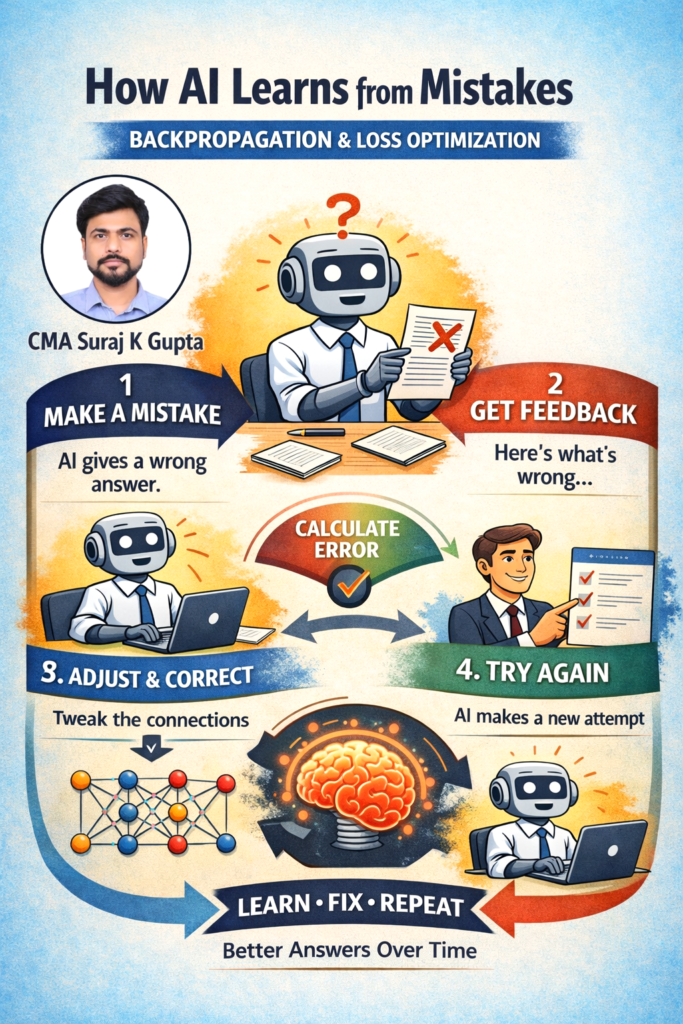
Imagine you assign your intern a task and they confidently submit their work. At first glance, it looks reasonable. But when you review it closely, you realize it is not correct.
Now you have two options.
You can fix the work yourself and move on.
Or you can explain what went wrong.
If you choose the second approach, something interesting happens.
You tell the intern where they made a mistake. You show them how far off they were. You guide them toward what a better answer would look like.
The intern takes that feedback, adjusts their approach, and tries again.
It is still not perfect.
So you repeat the process.
Again.
And again.
And again.
With each cycle, the intern improves slightly.
Over time, those small improvements compound into a significant increase in performance.
This is exactly how an AI system learns.
Behind the scenes, every prediction made by the model is compared to the correct answer. The system calculates how far off it was. This difference is called the “loss.”
Once the error is measured, the system sends feedback backward through its internal network. Each connection is adjusted just a little bit to reduce the error in the next attempt.
This continuous loop of prediction, error measurement, and adjustment allows the system to gradually improve.
In the world of artificial intelligence, this process is called Backpropagation and Loss Optimization.
While the terminology may sound complex, the core idea is simple and deeply human:
Learn from mistakes, correct them, and try again.
In fact, one of the most important insights about AI is this:
It is not intelligent because it is perfect.
It is intelligent because it has been trained on mistakes, repeatedly corrected, and continuously refined.
In the next episode, we will introduce a powerful new concept — a “teacher” that helps our intern decide what information to focus on and what to ignore.
Director’s Quick Brief
Key Concept
Backpropagation and Loss Optimization
Simple Definition
A process where an AI model improves by measuring its mistakes and adjusting itself to reduce errors over time.
Real-world Example
A new employee improves their performance by receiving feedback on their work, understanding what went wrong, and making adjustments with each attempt.
Playbook Progress
Season 1 – Raising the Intern
Episode 5 of 7