Episode 4 of 40
In our last episode, we discovered how our digital intern connects ideas using a massive web of invisible strings, much like a detective connecting clues on a corkboard.
But before any of that learning could even begin, something much less glamorous had to happen first.
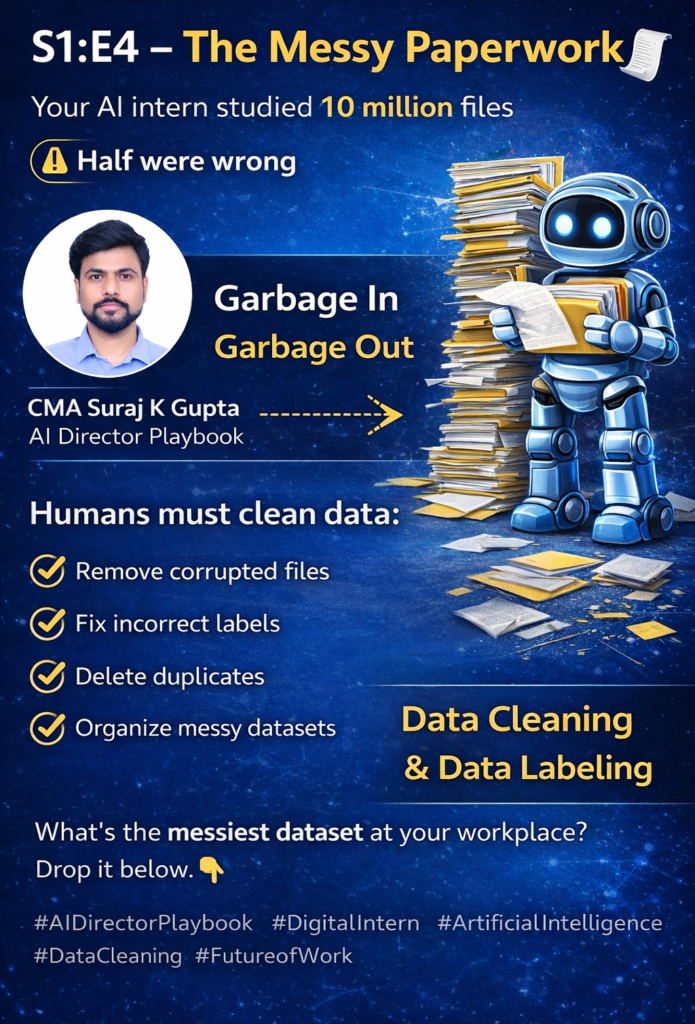
Someone had to organize the paperwork.
Imagine hiring a brand-new intern and giving them access to every single document your company has ever produced. Every email, report, presentation, image, and spreadsheet ever created.
At first glance, this sounds like an incredible advantage. After all, more information should mean better learning.
But there is a problem.
Real-world data is messy.
Company files are rarely clean, organized, or consistent. In fact, they often contain errors, duplicates, and mislabeled information. One customer might appear in three different formats: “Rahul Sharma,” “R. Sharma,” and “Rahul S.” Images might be incorrectly tagged. Documents may be corrupted. Entire folders might contain irrelevant or outdated information.
If our intern were to study this chaotic pile of paperwork directly, they would begin learning the wrong patterns.
This is where one of the most important principles in artificial intelligence comes into play:
Garbage in – Garbage out.
Before an AI model can be trained, teams of engineers and data specialists must carefully prepare the information it will learn from. This preparation process involves cleaning the data and labeling it correctly so that the system understands what each example represents.
For instance, imagine a training dataset used to teach an AI how to recognize images.
If a picture of a dog is mistakenly labeled as “cat,” the model will begin associating the wrong features with the wrong category. Multiply that mistake across thousands or millions of examples, and the entire system becomes unreliable.
So before the intern can begin learning patterns, humans step in to perform a massive organizational task.
They remove corrupted files.
They eliminate duplicates.
They fix incorrect labels.
They tag examples with the correct meaning.
Only after this painstaking cleanup process can the AI begin learning effectively.
In the technology world, this essential step is known as Data Cleaning and Data Labeling.
It may not sound glamorous, but it is one of the most critical stages in building any AI system. In fact, many AI teams spend more time preparing and cleaning their data than they do designing the models themselves.
Because even the most intelligent digital intern cannot succeed without organized paperwork.
In the next episode, we will explore something even more fascinating: how our intern learns to recognize when they have made a mistake — and how they gradually improve their performance over time.
Director’s Quick Brief
Key Concept
Data Cleaning and Data Labeling
Simple Definition
Preparing and correcting training data so an AI model learns the right patterns.
Real-world example
Cleaning duplicate CRM entries before training a customer prediction model.
Playbook Progress
Season 1 – Raising the Intern
Episode 4 of 7