
Episode 2 of 40
Welcome back to your role as 𝙏𝙝𝙚 𝘼𝙘𝙘𝙞𝙙𝙚𝙣𝙩𝙖𝙡 𝘼𝙄 𝘿𝙞𝙧𝙚𝙘𝙩𝙤𝙧. Our digital intern knows how to spot patterns, but how do they actually write entire emails and reports? 🏢
It all comes down to that massive stack of files they are carrying in our trailer image. 📂
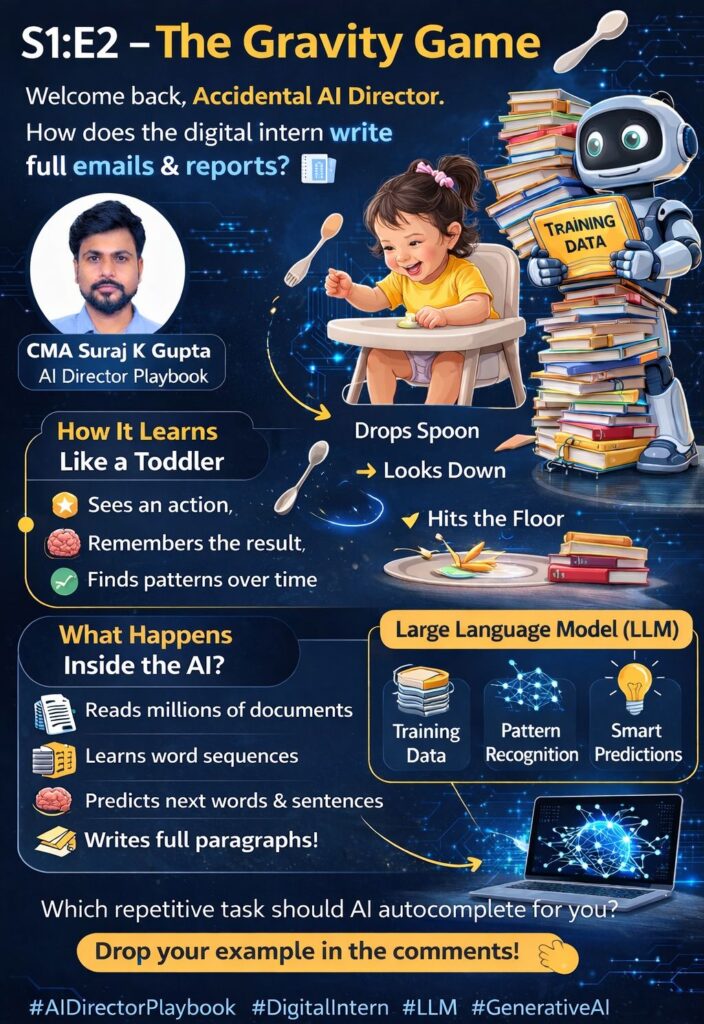
Think about how my two year old daughter plays the “dropping the spoon” game from her high chair. 🥄
When she lets go of the spoon, she immediately looks down at the floor. She has not studied the complex laws of physics. 🍎
She just knows from past experience that the action of “dropping” is always followed by the outcome of “hitting the floor.” 💥
Your digital intern does the exact same thing, just on a massive scale. It read every single document in that giant stack of files it is carrying. 📚
If you ask it to “Write a polite email delaying a project,” it does not actually understand what a project is, or what it means to be polite. ⏳
It just knows that in its stack of files, the word “Due” is almost always followed by “to,” then “unforeseen,” then “circumstances.” It drops those words in a perfect sequence, one after another. 🧩
It is not just autocompleting a single word – it is predicting entire paragraphs based on the patterns it memorized! 🪄
In the tech world, that giant stack of files is called the 𝙏𝙧𝙖𝙞𝙣𝙞𝙣𝙜 𝘿𝙖𝙩𝙖, and the system guessing the next word is called a 𝙇𝙖𝙧𝙜𝙚 𝙇𝙖𝙣𝙜𝙪𝙖𝙜𝙚 𝙈𝙤𝙙𝙚𝙡 (𝙇𝙇𝙈). 💻
What is a repetitive email or document you wish you could hand off to an intern to “autocomplete” for you? Drop it in the comments! 👇
Director’s Quick Brief
Key Concept
Large Language Models (Next Word Prediction)
Simple Definition
A Large Language Model generates text by predicting the most likely next word based on patterns it learned from massive amounts of written data.
Real-world Example
When Gmail suggests the rest of your sentence while writing an email, it is predicting the next word based on patterns learned from millions of similar emails.
Playbook Progress
Season 1 – Raising the Intern
Episode 2 of 7