Episode 14 of 40
In the previous episode, we saw how different systems can connect and work together. But connection alone is not enough.
The next challenge is finding the right information.
Imagine this.
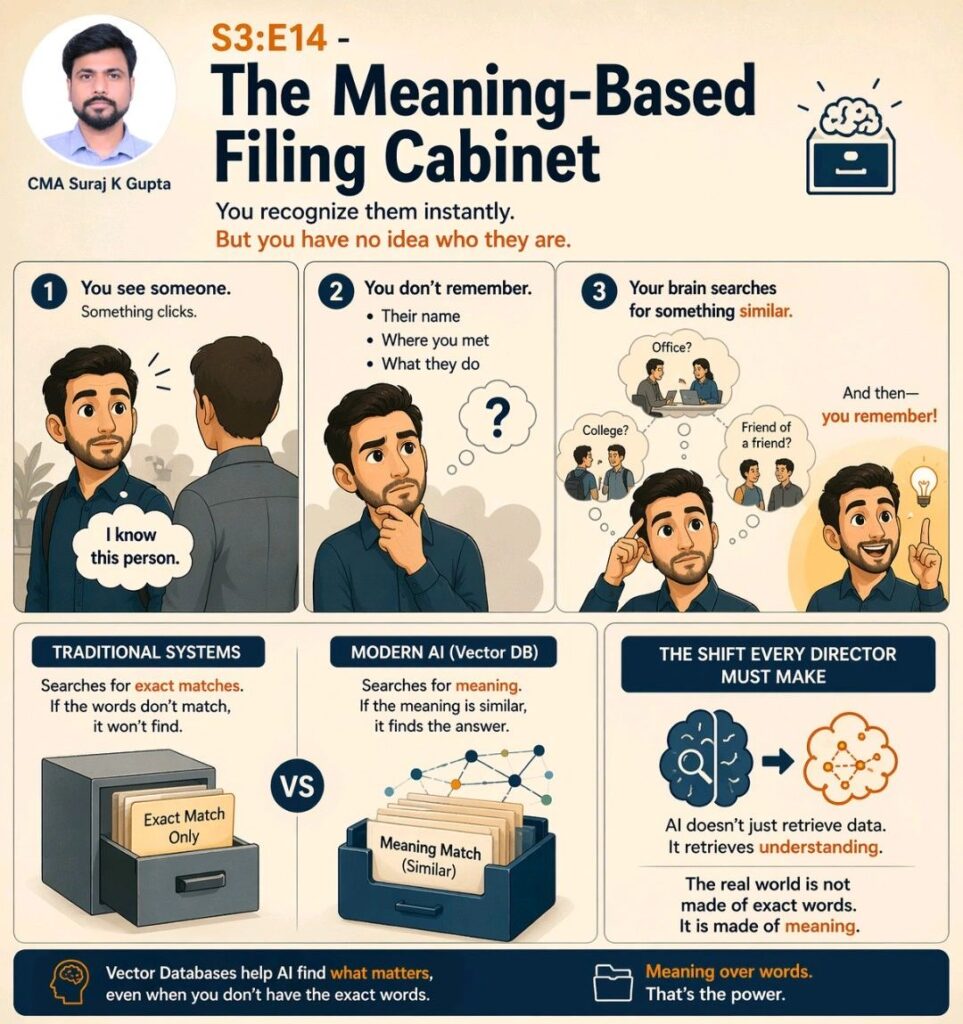
You see someone, and something feels familiar.
You are certain you have met them before.
But you do not remember their name.
You do not remember where you met them.
Still, your mind starts searching.
Office?
College?
Friend of a friend?
You are not looking for an exact match.
You are looking for something similar.
And then suddenly, the connection clicks.
Now think about your digital intern.
Traditional systems work like a strict filing cabinet. They retrieve information only when the exact name, keyword, or label is provided.
If the input is even slightly different, the system struggles to find the right result.
Modern AI works differently.
It does not search for exact words.
It searches for meaning.
Even if the wording changes, if the meaning is similar, the system can still retrieve the right information.
In artificial intelligence, this capability is powered by vector databases.
Instead of storing data as fixed labels, vector databases represent information in a way that captures meaning and relationships. This allows the system to find results based on similarity, not exact matches.
This is a fundamental shift.
The goal is no longer to match words.
It is to match meaning.
In the next episode, we will explore a practical limitation of this system — how much information AI can actually hold at once.
Director’s Quick Brief
Key Concept
Vector Databases
Simple Definition
A way of storing information so that it can be retrieved based on meaning and similarity, not just exact keywords.
Real-world Example
Recognizing someone without remembering their name, and still being able to figure out where you know them from.
Playbook Progress
Season 3 – Setting Up Their Desk
Episode 14 of 16