
Episode 15 of 40
In the previous episode, we explored how AI can find information based on meaning. But even with this capability, there is a practical constraint.
It cannot hold everything at once.
Imagine this.
Someone gives you a list of instructions.
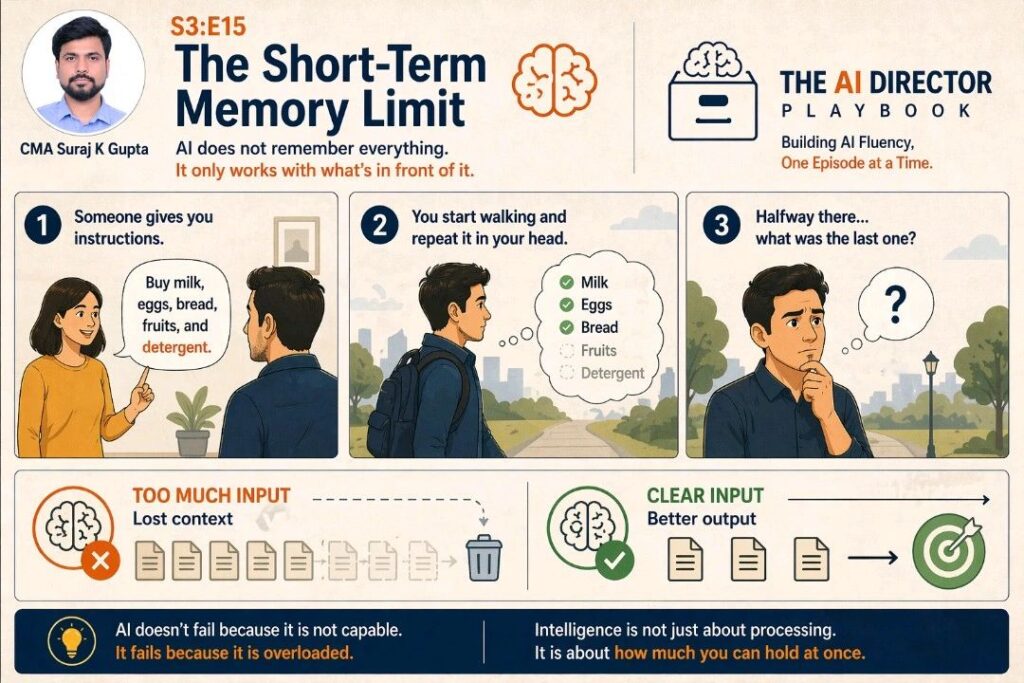
“Buy milk, eggs, bread, fruits, and detergent.”
You start walking.
You repeat the list in your head.
Milk… eggs… bread…
Halfway there, you pause.
What was the last one?
You did not ignore the instruction.
You simply could not hold all of it at once.
Now think about your digital intern.
AI works in a similar way.
It does not remember everything. It only works with the information that is currently available in its working space.
As more information is added, older parts begin to drop out. The system prioritizes what is most recent, and anything beyond its limit is no longer considered.
In artificial intelligence, this limitation is known as the context window.
The context window defines how much information the model can process at a given time. If the input exceeds this limit, earlier details may be lost, which can affect the quality of the output.
This explains why sometimes AI responses feel incomplete or inconsistent.
The issue is not capability.
It is capacity.
In the next episode, we will explore how this limitation is addressed by bringing the right information back when needed.
Director’s Quick Brief
Key Concept
Context Window
Simple Definition
The amount of information an AI system can hold and process at one time.
Real-world Example
Trying to remember a list of instructions while walking, and forgetting some items along the way.
Playbook Progress
Season 3 – Setting Up Their Desk
Episode 15 of 16