
Episode 12 of 40
In the previous episode, we explored how choosing the right model impacts performance and efficiency. But even the best model faces a limitation.
It cannot do everything on its own.
Imagine an office environment.
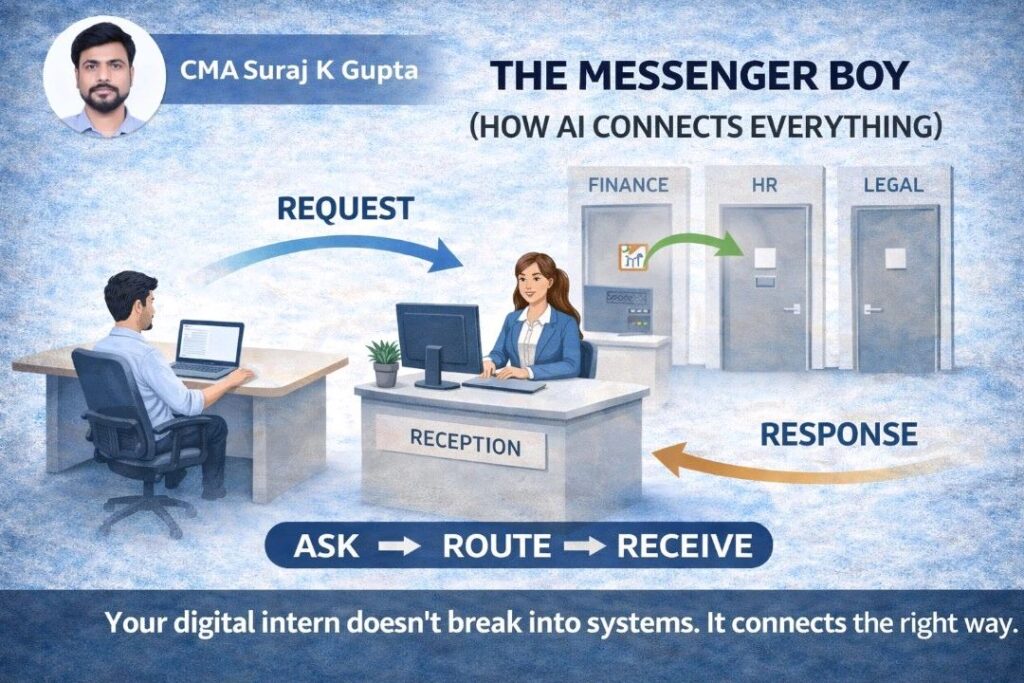
Your intern needs information from another department — finance, HR, or legal. They cannot simply walk in and take what they need. There is a process.
They go to the reception desk.
The request is noted, verified, and then routed to the correct department. The response follows the same structured path back.
This system exists for a reason. It ensures control, security, and clarity.
Now think about your digital intern.
It works in a very similar way.
AI systems do not directly access external tools, databases, or applications. Instead, they send structured requests through defined channels, receive responses, and then act on them.
This is what allows AI to interact with the outside world safely and effectively.
In artificial intelligence, these structured communication channels are called APIs.
APIs act as the messenger system between different software components. They enable one system to request data or actions from another without needing to understand how it works internally.
This is why modern AI feels powerful.
Not because it knows everything.
But because it knows how to connect and request the right information at the right time.
In the next episode, we will take this one step further — from simply sending requests to seamlessly connecting multiple systems through a unified approach.
Director’s Quick Brief
Key Concept
APIs
Simple Definition
A structured way for different systems to communicate by sending requests and receiving responses.
Real-world Example
When your intern asks the reception desk to fetch a document from another department, the request is routed correctly and the response comes back through the same channel.
Playbook Progress
Season 3 – Setting Up Their Desk
Episode 12 of 16