
Episode 11 of 40
In the previous episode, we explored how different types of AI models bring different strengths. But even with the right model, there is another layer most people overlook.
Where does the work actually happen?
Imagine this.
You hire a new intern.
You assign them tasks.
But before they begin, you need to decide one simple thing.
Where will they sit?
You have multiple options.
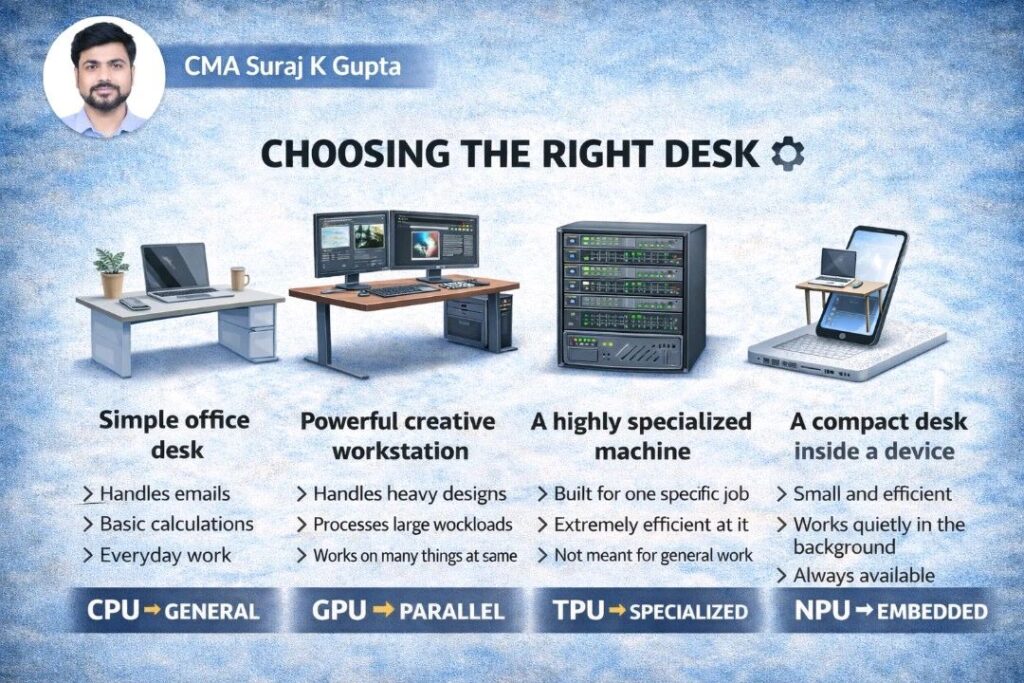
You can give them a basic office desk.
It is reliable.
It handles emails, documents, and everyday work.
Nothing fancy, but it gets the job done.
Or…
You can place them at a powerful workstation.
Built for heavy tasks.
Capable of handling large workloads.
Able to work on many things at once.
Or…
You can assign them to a specialized machine.
Designed for one specific type of work.
Extremely efficient at it.
But not useful outside that purpose.
Or even…
You can give them a compact setup inside a device.
Small.
Efficient.
Always running quietly in the background.
Same intern.
Same skills.
Different desk.
Different performance.
Now think about your digital intern.
These “desks” are actually the processors that power AI systems.
In artificial intelligence, they are called CPU, GPU, TPU, and NPU.
Each one is designed for a different kind of work.
The CPU is the general-purpose worker.
The GPU handles large amounts of work in parallel.
The TPU is built specifically for AI-related tasks.
And the NPU works inside devices, enabling fast and efficient processing on the edge.
The difference is not in intelligence.
It is in environment.
And that changes everything.
Because performance is not just about how capable your intern is.
It is about where they are placed.
In the next episode, we will move from where your intern sits to how they communicate — and why that connection is critical.
Director’s Quick Brief
Key Concept
CPU vs GPU vs TPU vs NPU
Simple Definition
Different processors are designed for different types of work — from general tasks to parallel processing, specialized AI workloads, and efficient on-device operations.
Real-world Example
Using a basic laptop for emails, a powerful workstation for video editing, a specialized system for AI training, and a smartphone chip for running AI features directly on your device.
Playbook Progress
Season 2 – Hiring the Right Intern
Episode 11 of 4