Episode 9 of 40
In the previous episode, we looked at choosing the right kind of intern. But even after making that choice, there is another practical decision every Director faces.
Should you always use the most powerful option available?
Imagine this.
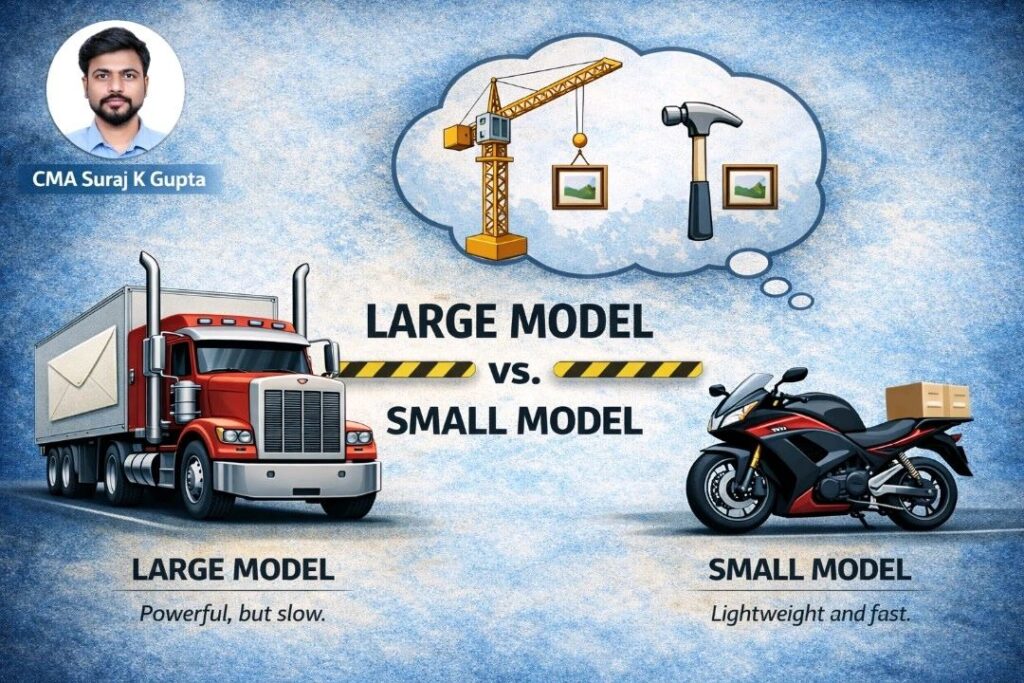
You need to deliver a small package across the city.
You have two options.
You can send a huge truck.
It can carry anything.
It is powerful.
It is built for heavy loads.
Or…
You can send a bike.
It is fast.
It is efficient.
It is just enough for the job.
Both will get the package delivered.
But one is clearly overkill.
In fact, it is like using a crane to hang a small photo frame.
The tool is not wrong.
It is just not meant for that job.
Now think about your digital intern.
Some AI models are extremely powerful.
They are trained on massive amounts of data and can handle complex reasoning, long documents, and detailed tasks.
Others are smaller and more focused.
They are faster, cheaper to run, and efficient for everyday work.
In artificial intelligence, this difference is known as Large Language Models and Small Language Models.
Large models bring depth and capability.
Small models bring speed and efficiency.
The real skill is knowing when to use which.
Because the goal is not to use the most powerful system.
It is to use the right system.
In the next episode, we will explore another important decision: whether to rely on one generalist intern for everything, or build a team of specialists for specific tasks.
Director’s Quick Brief
Key Concept
Large Language Models vs. Small Language Models
Simple Definition
Large models are trained on massive datasets and handle complex tasks, while small models are lighter, faster, and designed for simpler, focused tasks.
Real-world Example
Using a powerful AI model for detailed analysis or long reports, versus using a smaller model for quick summaries, emails, or routine tasks.
Playbook Progress
Season 2 – Hiring the Right Intern
Episode 2 of 4